How to Read the Japanese Kana Chart: A Beginner’s Guide
Make sense of the gojuon chart, connect hiragana with katakana, and start reading short words instead of memorizing the chart only in order.
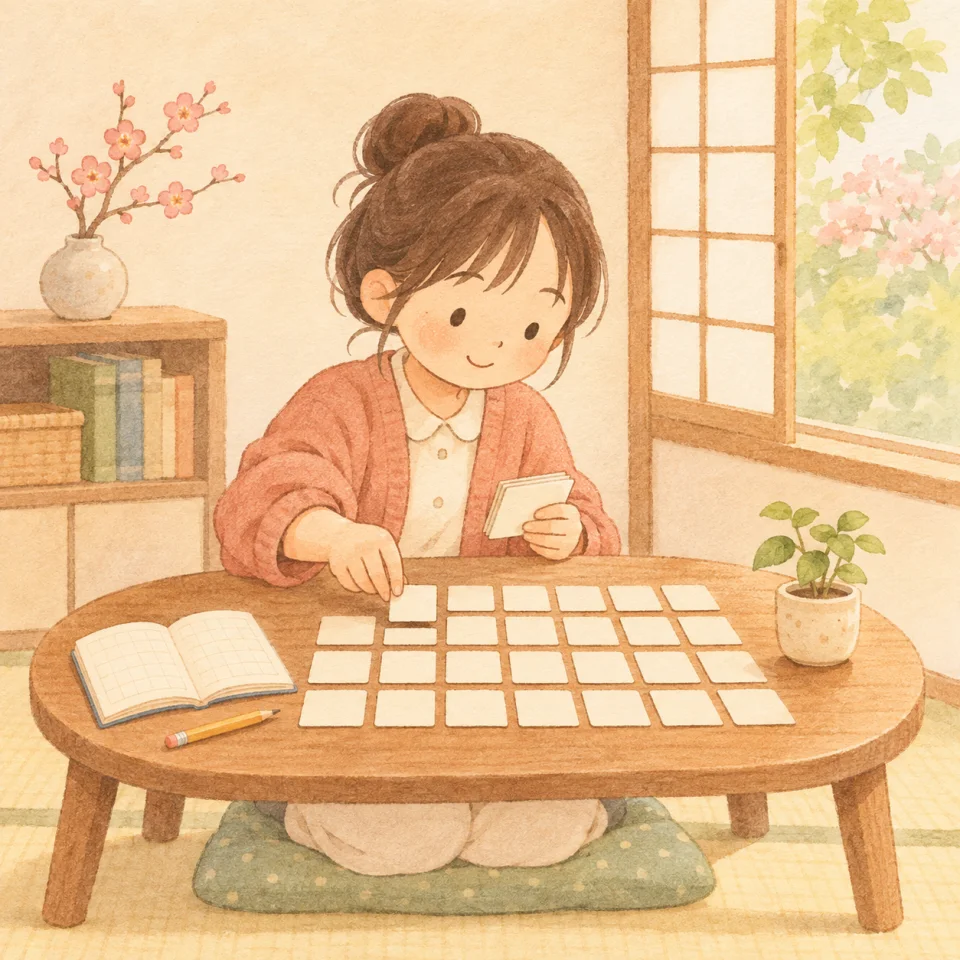
Find your way around the chart
Start with the five vowels: a, i, u, e, o. Across the ka row, the same vowel pattern gives you ka, ki, ku, ke, ko. These patterns make the chart a useful map: you can locate a character even before every shape feels familiar.
Some spaces in the ya and wa rows are empty. Nothing is missing from the chart. The final ん is learned separately. Your eventual goal is to recognize a character on its own, without reciting every row that comes before it.
| a | i | u | e | o |
|---|---|---|---|---|
| あa Play Japanese pronunciation of あ | いi Play Japanese pronunciation of い | うu Play Japanese pronunciation of う | えe Play Japanese pronunciation of え | おo Play Japanese pronunciation of お |
| かka Play Japanese pronunciation of か | きki Play Japanese pronunciation of き | くku Play Japanese pronunciation of く | けke Play Japanese pronunciation of け | こko Play Japanese pronunciation of こ |
| さsa Play Japanese pronunciation of さ | しshi Play Japanese pronunciation of し | すsu Play Japanese pronunciation of す | せse Play Japanese pronunciation of せ | そso Play Japanese pronunciation of そ |
| たta Play Japanese pronunciation of た | ちchi Play Japanese pronunciation of ち | つtsu Play Japanese pronunciation of つ | てte Play Japanese pronunciation of て | とto Play Japanese pronunciation of と |
| なna Play Japanese pronunciation of な | にni Play Japanese pronunciation of に | ぬnu Play Japanese pronunciation of ぬ | ねne Play Japanese pronunciation of ね | のno Play Japanese pronunciation of の |
| はha Play Japanese pronunciation of は | ひhi Play Japanese pronunciation of ひ | ふfu Play Japanese pronunciation of ふ | へhe Play Japanese pronunciation of へ | ほho Play Japanese pronunciation of ほ |
| まma Play Japanese pronunciation of ま | みmi Play Japanese pronunciation of み | むmu Play Japanese pronunciation of む | めme Play Japanese pronunciation of め | もmo Play Japanese pronunciation of も |
| やya Play Japanese pronunciation of や | ゆyu Play Japanese pronunciation of ゆ | よyo Play Japanese pronunciation of よ | ||
| らra Play Japanese pronunciation of ら | りri Play Japanese pronunciation of り | るru Play Japanese pronunciation of る | れre Play Japanese pronunciation of れ | ろro Play Japanese pronunciation of ろ |
| わwa Play Japanese pronunciation of わ | をo Play Japanese pronunciation of を | |||
| んn Play Japanese pronunciation of ん |
VOICEVOX:四国めたん
Meet the same sounds in katakana
Hiragana あ and katakana ア represent the same basic sound. So do か and カ, or し and シ. You are learning two sets of written shapes, rather than two separate sets of basic pronunciations.
Hiragana appears frequently in grammatical endings and particles. Katakana is common in loanwords and foreign names. Compare the charts, but practice recognizing each script in real words. Use the speaker beneath each romanized reading to hear the corresponding sound.
Why the chart shows o for を
In modern standard Japanese, を normally sounds the same as お, so this chart uses o as a pronunciation cue. You may type wo to enter を on a keyboard; that input sequence does not tell you to add a w sound. The corresponding katakana ヲ follows the same pronunciation.
| a | i | u | e | o |
|---|---|---|---|---|
| アa Play Japanese pronunciation of ア | イi Play Japanese pronunciation of イ | ウu Play Japanese pronunciation of ウ | エe Play Japanese pronunciation of エ | オo Play Japanese pronunciation of オ |
| カka Play Japanese pronunciation of カ | キki Play Japanese pronunciation of キ | クku Play Japanese pronunciation of ク | ケke Play Japanese pronunciation of ケ | コko Play Japanese pronunciation of コ |
| サsa Play Japanese pronunciation of サ | シshi Play Japanese pronunciation of シ | スsu Play Japanese pronunciation of ス | セse Play Japanese pronunciation of セ | ソso Play Japanese pronunciation of ソ |
| タta Play Japanese pronunciation of タ | チchi Play Japanese pronunciation of チ | ツtsu Play Japanese pronunciation of ツ | テte Play Japanese pronunciation of テ | トto Play Japanese pronunciation of ト |
| ナna Play Japanese pronunciation of ナ | ニni Play Japanese pronunciation of ニ | ヌnu Play Japanese pronunciation of ヌ | ネne Play Japanese pronunciation of ネ | ノno Play Japanese pronunciation of ノ |
| ハha Play Japanese pronunciation of ハ | ヒhi Play Japanese pronunciation of ヒ | フfu Play Japanese pronunciation of フ | ヘhe Play Japanese pronunciation of ヘ | ホho Play Japanese pronunciation of ホ |
| マma Play Japanese pronunciation of マ | ミmi Play Japanese pronunciation of ミ | ムmu Play Japanese pronunciation of ム | メme Play Japanese pronunciation of メ | モmo Play Japanese pronunciation of モ |
| ヤya Play Japanese pronunciation of ヤ | ユyu Play Japanese pronunciation of ユ | ヨyo Play Japanese pronunciation of ヨ | ||
| ラra Play Japanese pronunciation of ラ | リri Play Japanese pronunciation of リ | ルru Play Japanese pronunciation of ル | レre Play Japanese pronunciation of レ | ロro Play Japanese pronunciation of ロ |
| ワwa Play Japanese pronunciation of ワ | ヲo Play Japanese pronunciation of ヲ | |||
| ンn Play Japanese pronunciation of ン |
VOICEVOX:四国めたん
Turn a few characters into words
You do not need to finish both charts before doing anything with them. After learning the vowel row, try reading いえ, “house.” Add the ka row and try かお, “face.” A small amount of useful reading is more motivating than another attempt to recite the whole chart.
Try this short routine:
- Listen to a few sounds and repeat them while looking at the characters.
- Shuffle the characters and read them in a different order.
- Read a word made from characters you already know.
- Review those characters before adding more the next day.
Romanization is a temporary aid. Japanese vowels do not follow the variable spelling rules of English: resist reading a kana sequence as if it were an English word.
Deal with look-alikes early
Put confusing pairs side by side: ぬ/め and れ/ね in hiragana, シ/ツ and ソ/ン in katakana. Look for the specific stroke that distinguishes them, then read each one inside a word. For handwriting, use a stroke-order model as well; a printed font does not show you how a character is written.
Where to go next
The basic chart is your starting point. Continue with dakuten and handakuten for が and ぱ, then small-kana combinations such as きゃ. You will also meet long vowels and small っ as you read more words. Keep building from examples rather than trying to memorize every sound rule at once.
Practice with word cards
Read next

Writing & Pronunciation
Dakuten and Handakuten: Reading が, ざ, だ, ば, and ぱ
Learn what the two dots and small circle do, compare hiragana and katakana, and practice the sound distinctions inside familiar Japanese words.
Writing & Pronunciation
Small ゃ, ゅ, ょ: How Japanese Combined Sounds Work
Read combinations such as きゃ and しゅ as one beat, compare hiragana with katakana, and hear why びょういん and びよういん are different words.
Writing & Pronunciation
What Is Hiragana? How It Works and How to Start Learning
See how hiragana carries words, particles, and verb endings, then build a practice routine that connects each shape with a sound and a useful word.

Writing & Pronunciation
How to Read Katakana: Loanwords, Long Vowels, and Common Traps
Start with familiar words such as コーヒー and テレビ, then learn to notice long-vowel marks, small kana, and easily confused character shapes.