Japanese Greetings: When to Say Ohayou, Konnichiwa, and Konbanwa
Choose a greeting that fits the time and the relationship, learn the standard spellings, and keep evening hellos separate from bedtime goodbyes.
Choose for the person as well as the time
If you meet a teacher or someone you do not know well in the morning, おはようございます is a useful polite choice. With a close friend or family member, おはよう may fit the relationship better.
English “hello” can cover many situations. Japanese greetings often make the time of day more visible, so learn them with a setting in mind rather than treating こんにちは as a replacement for every English hello.
| Expression | Typical setting | Remember |
|---|---|---|
| おはようございます | A polite morning greeting | A useful starting choice with teachers or less familiar people |
| おはよう | A casual morning greeting | Best chosen with the relationship in mind |
| こんにちは | A daytime hello | The final は is pronounced wa |
| こんばんは | An evening hello | Different from saying good night before bed |
Learn the spelling along with the sound
こんにちは and こんばんは end in written は, pronounced wa. Their standard spellings are not こんにちわ and こんばんわ. Remember the greeting as a complete word instead of reconstructing it from romanization.
A greeting can also lead into a short exchange. The next example adds a polite phrase that makes sense when people are about to spend the day working or learning together.
おはようございます。今日もよろしくお願いします。
An evening hello is not a bedtime goodbye
Use こんばんは when meeting someone in the evening. おやすみなさい belongs to bedtime or a related late-evening farewell. Saying it as soon as you meet a neighbor outside may suggest you are ending the interaction rather than opening it.
Notice local habits without overgeneralizing
Some workplaces use おはようございます for the first meeting of a shift, even when it is no longer morning. Treat that as a habit of a particular setting, rather than a rule for all Japanese conversations. Start with ordinary everyday usage, then pay attention to what people around you actually say.
Try two situations
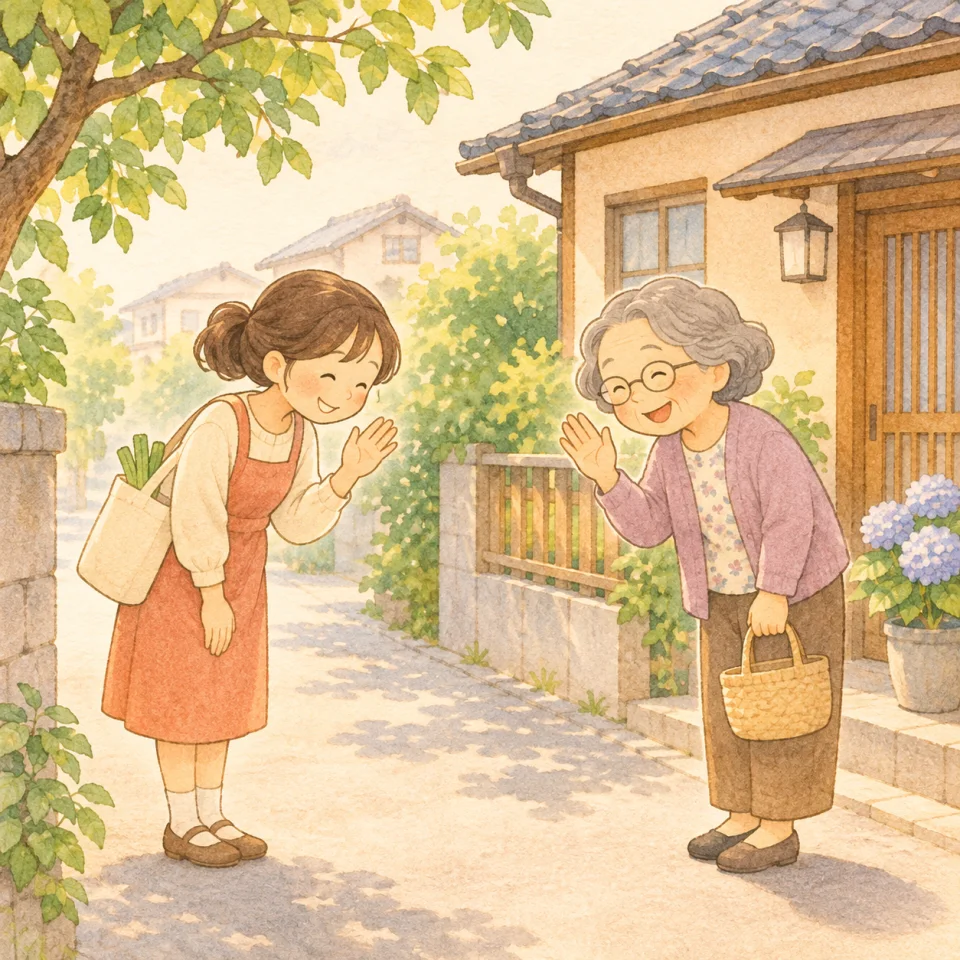
You meet your teacher early in the morning: おはようございます is a good fit. You meet a neighbor after dark: こんばんは works as an evening hello. Now imagine the morning encounter is with a close friend. Would the shorter おはよう suit your relationship?
If you are still learning the written forms, the hiragana guide will help you read the expressions directly.