Japanese Word Order: Finding the Verb and Following the Particles
Learn why Japanese often places the verb at the end, how particles show relationships, and why a natural sentence may leave the subject unsaid.
Start with a simple action
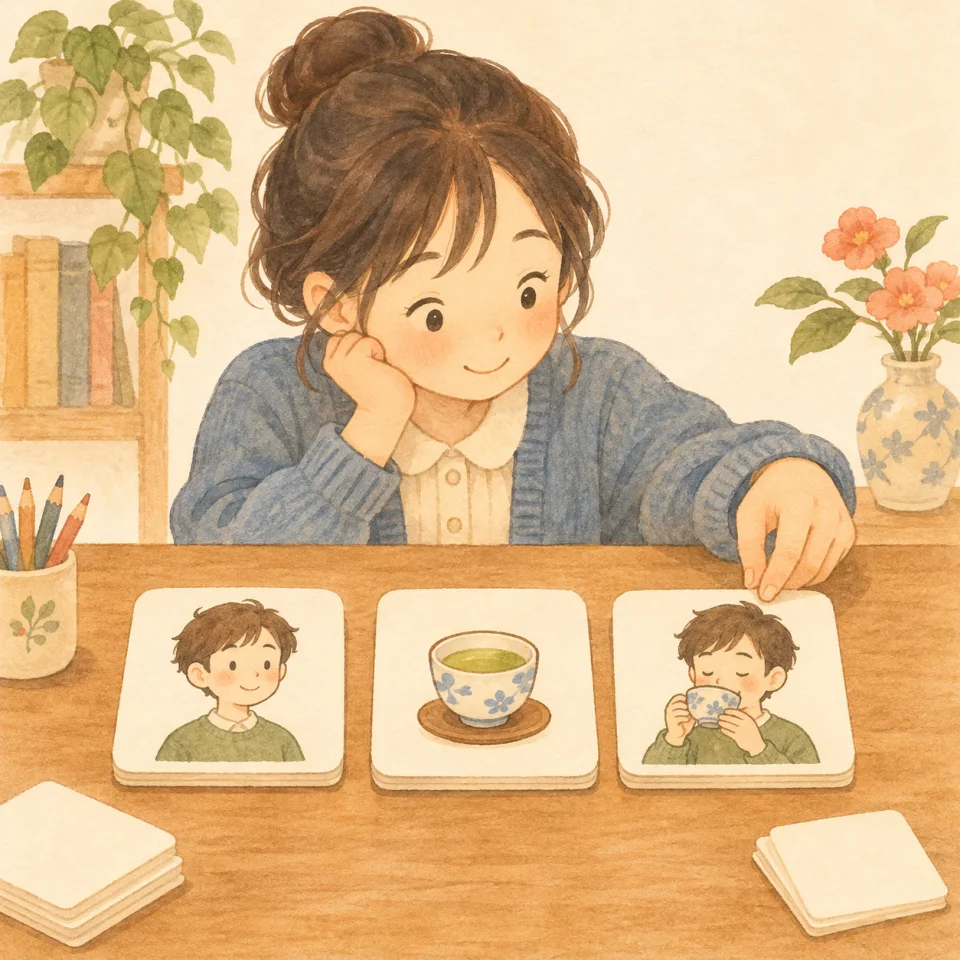
English usually places the verb before its object: “I drink tea.” A basic Japanese version is 私はお茶を飲みます. The tea comes before 飲みます, “drink.” This is why introductory descriptions often call Japanese an SOV, or subject–object–verb, language.
Use that label as an initial guide, rather than a template that every sentence must visibly fill. The topic marked by は is not always the grammatical subject, and predicates can express a state or identity as well as an action.
私はお茶を飲みます。
Read the particles with the words before them
In 図書館で本を読みます, で marks the library as the place where reading happens, and を marks the book as the object. These small markers do work that English often handles through word order or prepositions.
Look for units such as 図書館で and 本を, rather than assigning meaning to a noun in isolation. Japanese allows some changes in phrase order, but that does not make every arrangement equally natural.
図書館で本を読みます。
A missing subject is often understood
In a conversation about lunch, もう食べました can be a perfectly useful answer: “I’ve already eaten,” if the context makes “I” clear. Repeating 私は in every sentence can sound unnecessary.
The important word is context. Japanese does not secretly mean “I” whenever no subject is written. The understood person could be someone else, depending on the conversation.
明日、学校へ行きます。
Build a reading habit around three questions
- What does the final predicate say is happening, or what state does it describe?
- Which particles identify the object, location, or destination?
- What information is already clear from the surrounding conversation?
A common word-order mistake, then a quick check
Avoid carrying English subject–verb–object order straight into a basic Japanese statement: 私は飲みますお茶を is not the pattern to practice here. Start with 私はお茶を飲みます, placing the predicate last. You can also leave out 私は when the speaker is already clear.
Arrange 本を / 読みます / 図書館で to say that someone reads a book at the library. Which unit marks the location, and which marks the object?
One answer is 図書館で本を読みます: で marks the location of reading, and を marks what is read. 本を図書館で読みます is also grammatical; context affects which order sounds most natural.